1.85
C#
This flute has a very distinct personality. It is a solid and dense
piece. Its tone is dark, smooth, subtle and very expressive. Entirely
jinashi bore with red lacquer. Black lacquer exterior. The kinko
utaguchi is made from vegetable ivory and lined in silver. A very nice
flute.
1.9 (C#)
This is an extremely thick walled, dense, heavy piece of Madake
that I harvested in Japan. The diameter at the blowing edge is 2
inches. (much wider than most shakuhachi) The root diameter is 2 3/4
inches. This is a jiari shakuhachi; meaning the bore has been built up
to precise measurement. Its tone is powerful and crisp. A very unique
flute.
3.0
Mujitsu Taimu (E) This is is probably the fattest flute I've ever made. The
outside diameter at the blowing edge end is 6 cm. The diameter at the
root is 7.5 cm. The average circumference along the length of the
flute is 17 cm. I can't connect my hand around it! The
circumference at the root is 23.5 cm.
The challenge in making wide bore flutes like this is that there are so
many things that can go wrong. To begin with, it is really pusing the
physical limits of playability to start with such a wide bore to length
ratio. However, the advantage is that if one can pull it off and make
the right compromises inside the bore, the sweet spot becomes such a
physical pleasure to play.
2.6 Mujitsu
Taimu (G)
This is another of the large "Taimu"
honkyoku style of shakuhachi I've been working on lately. Mujitsu Taimu
Shakuhachi are characterized by a wide bore and a breathy, windy tone.
This particular peice of madake has been around the shop for years. In
the last few months, I've focused on developing the tone of this flute.
It is now my current favorite.
An enjoyable discovery with shakuhachi is the experience of subtley
under the surface. This flute is an excellent example of this often
hidden world of subtlety. At first play this flute has a satisfying,
understated, soft windy tone. For the receptive player, many unforseen
expressive possibilities are revealed with persistence. This
flute is best played by "breathing" through it, rather than pushing the
sound out. This is an excellent flute for breath training.
As a flutemaker, it is very satisfying to make a flute that
doesn't give itself away at first play. The challenge becomes combining
mystery with substance. This flute is going in the right direction. It
is recommended for players with some experience with shakuhachi.
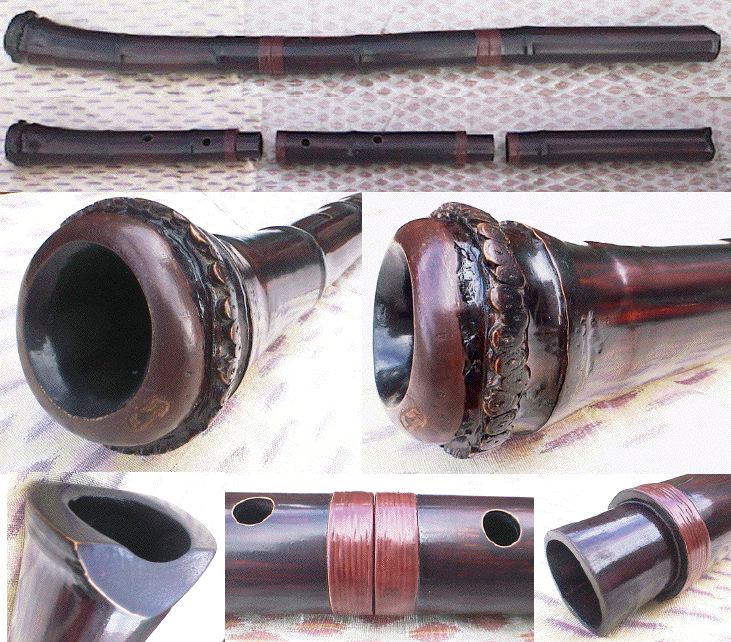
This is a two-peice shakuhachi. The large holes have been slightly
grooved for playing comfort, as well as for tone and pitch adjustment.
They are offlined slightly for right handed players. (right hand on the
bottom end of the flute) The bore is lined with red urushi. The
exterior has multiple coats of polished black urushi. Decorative
interwoven rattan binding has also been added and painted with red
urushi. Feel free to contact
me
with any questions.
1.85 C/C#
This is a dense, solid piece of bamboo with an elegant upturned root.
It's tone is smooth and powerful. The bore is jinashi except for a very
small dab of ji paste at one area. Black urushi lacquer exterior, red
urushi bore. Kinko utaguchi.
2.9 Mujitsu Taimu
This 2.9 is another of the large, honkyoku style bass shakuhachi I've
been working on lately. Like most of the Taimu that I've been turning
out, this flute has a distinctive big, wide, breathy, wild tone. A very
expressive flute. Urushi has been applied to both the bore and
exterior. Tuned between F and F#.Additional details
about
Mujitsu Taimu Shakuhachi.
2.3 A
This flute is a good choice for someone with smaller hands/fingers who
desires a low tone. It is tuned to (A) yet is smaller (2.3) than the
average jiari 2.4 (A) This makes the fingering reach easier. It is also
a relatively lightweight flute for its size. The tone is open, deep,
breathy and satisfying. The second register plays extremely easy and
sweet as well. Red lacquered bore, black lacquered exterior. Kinko
utaguchi.
1.7 (D - Eb)
This is a very attractive piece of Japanese Madake bamboo. It has an
elegant, sculpted root and exotic coloring. Its tone is sweet and
delicate. It is entirely jinashi except for the addition of a small
amount of ji paste which improves its playability. It is lightweight
and very easy to play. Tuned between D and Eb.
3.3
Mujitsu Taimu Mujitsu
Taimu shakuhachi are characterized by a wide
bore and a deep, low, windy, breathy tone. The tone is wild and
natural, yet the flute still maintains good balance, tuning and
playability. Additional details about
Mujitsu Taimu Shakuhachi.
2.7
Mujitsu Taimu Another
example of the wide bore, breathy, honkyoku shakuhachi. There will be
more flutes in this style coming soon. Please contact me for prices and
availablility. Additional details about
Mujitsu Taimu Shakuhachi.
2.9 Mujitsu
Taimu This
2.9 Mujitsu Taimu Shakuhachi was
made in three pieces making it a functional travel flute. Its tone is
hollow, glowing and ephemeral.
1.5
(E) This flute has a
relatively bright tone for a jinashi shakuhachi. It plays with good,
clear power. Kinko utaguchi. Black urushi bore.
1.85 One of
the most interesting and satisfying characteristics of working in the
jinashi method is the unpredictablility of the natural bore of bamboo.
There is an endless variety of tone personality found with this method.
My job is to recognize it, then develop it. Sometimes, as with this
flute, an even more unexpected, unique voice introduces
itself.
This flute has a unique
combination of tone characteristics; quick yet subtle attack
- soft, smooth and delicate - sweetly expressive - airy, light,
ephemeral - delicate vibration in the hands and body. Subtle
power. ---- Sculptural, rounded root. A nice shakuhachi. Tuned
between C and C#. (Closer to C so it can be pitched down to C without
difficulty). (This flute as since been
painted partially black - see photo above)
1.9 (C)
This flute has an unmistakable open, windy jinashi tone. It is a very
expressive sounding flute, with good resistance and fluid playability.
For a wide bore flute, it plays very well into the third octave. Tuned
to C. A good flute for someone looking for the classic, natural jinashi
sound. Entirely jinashi bore, sealed with red urushi. Myoan utaguchi.
2.0
This flute is sealed with a thin layer of ji paste. Its tone color is
rich, direct and focused. The attack is very quick with good volume.
Relatively lightweight and sleek. Plays strong and very easily with
good balance. Tuned to itself between B and C. Kinko utaguchi. Red
urushi bore.
2.0
(B) This is a very unique, high quality flute. It is
currently one of my favorites. The tone is introverted and slightly
airy. What distinguishes it from many other flutes is that it has a
very distinct "glow." It's playability is very smooth and fluid.
The attack is quick but not overpowering. The second register is very
easy and sweet. These qualities are similar to some of the finer
jinashi Komuso flutes I've played. The exterior has been painted with
black urushi in the style of the Komuso shakuhachi. The jinashi
interior is coated with red urushi. It has an organic, sleek, elegant
look and feel. It is slightly over 2.0 and is well tuned to (B). Kinko
utaguchi.
1.9 This piece
has developed over the last few
years into my favorite flute. It covers a wide spectrum of tone colors.
Mysterious yet direct. Subtle yet with presence. It has a velvety
playability which is very satisfying. Its tone is fashioned after some
of the finer vintage jinashi flutes I've had the opportunity to play
and study. Elegant, lightweight, and comfortable to play. Very nice
vibration in the hands. The exterior is coated with black urushi. Kinko
utaguchi.
 Mujitsu Shakuhachi